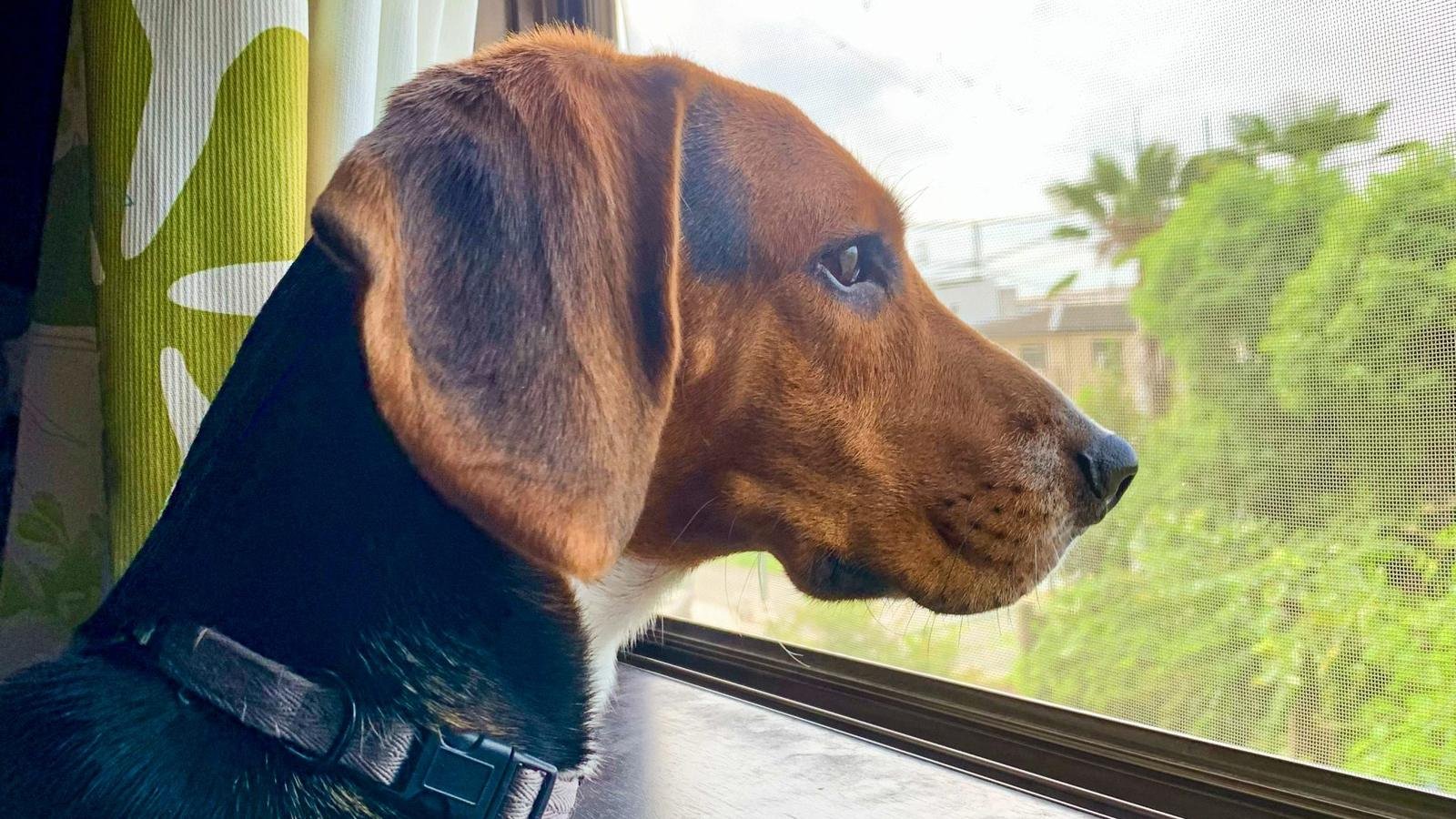
The separation anxiety in dogs starts when you leave: distress, crying, and damage to doors and windows. A bored dog, on the other hand, destroys things at any time and settles down as soon as you give them something to do.
Boredom is solved with exercise and activity. Anxiety needs gradual departures and, if it's serious, a professional. A chew keeps them busy; it doesn't treat anxiety.
You come home to a scratched door, a gutted cushion, or a neighbor telling you your dog has been barking for two hours. Almost everyone thinks the same thing: "they misbehaved." But behind that mess there could be two very different problems, and what works for one doesn't work for the other. This guide helps you tell them apart, explains what to do in each case, and makes clear when it's time for professional help.
Boredom or anxiety: how to tell them apart
Both cause damage, but they're not alike. The difference lies in when it happens, where and what else comes with it.
| Bored dog | Separation anxiety | |
|---|---|---|
| When | At any time, even when you're home | When you leave or get ready to go out; it usually starts shortly after you leave |
| Where | Wherever the interesting object is: shoes, cushions, cables | Doors, frames, windows: ways out |
| What else you see | Energy to spare, looking for play | Sustained crying or barking, panting, restlessness, urine or feces in an already house-trained dog |
| With an activity | They get absorbed and it passes | Sometimes they don't even touch it |
| Before you leave | Nothing special | They get restless when they see your keys or shoes |
These signs match those described by the ASPCA, which also warns that damage to doors and windows can lead to broken teeth and injured paws.
The cheapest test: leave your phone recording, propped on a piece of furniture, and go out for twenty minutes. You'll see whether they play and lie down to sleep, or cry, scratch at the door and can't settle. It's the information any professional will ask you for.
If your dog is bored: enrichment
A bored dog doesn't have a distress problem: they have energy and a mind with nothing to do. The ASPCA notes that chewing is normal behavior that, among other things, fights boredom. If you don't give them something they're allowed to chew, they'll find something themselves.
Enrichment means giving them activities that resemble what a dog would naturally do: sniff, search, chew, solve. Ideas that work in any apartment:
- Sniff walks. A walk where they can sniff at their own pace tires them out more than a long, brisk one.
- Scent games. Hide bits of treats around the living room and let them search. Small pieces that break easily work well, like beef lung or liver biscuits.
- Treat-dispensing toy. Part of their meal inside a toy they have to move or lick to empty. The food lasts longer and makes them think.
- Toy rotation. Put away half and swap them every few days. New things become interesting again.
- Supervised chewing. A natural chew gives them a long stretch of activity while you're nearby.
- Short training sessions. Five minutes learning something new tires the mind more than half an hour of fetch.
If they also chew everything and they're a puppy, they may be in the middle of teething, which according to the ASPCA usually lasts until six months. The key there is to give them allowed objects and put forbidden ones out of reach.
Separation anxiety: what triggers it
- Changes in routine. A move, a new work schedule, someone who moved out.
- Going back to the office after a period of being home a lot.
- Never having learned to be alone. Common in puppies who spent their first months with constant company.
- Very emotional goodbyes and arrivals. They make leaving seem like a huge deal.
- Punishment when you get back. The dog doesn't connect the scolding with what they did hours ago: they connect your arrival with something bad, and things get worse.
The plan that actually works
There's no shortcut. What works is systematic and takes patience. For mild cases, the ASPCA describes counterconditioning: gradually associating being alone with something pleasant.
- Burn energy before you leave. A real walk, with sniffing. A tired dog handles being alone better.
- Break the departure ritual. Pick up your keys and sit down. Put on your shoes and don't leave. Repeat until those cues no longer signal anything.
- Increase the time little by little. Step out for thirty seconds and come back. Then two minutes, then five. Only move forward when the previous step leaves them indifferent; if a jump overwhelms them, go back.
- Leave without a goodbye and come back without a fuss. Greet them once they're calm.
- Something pleasant that only appears when you leave. A food toy or a special treat that's taken away when you return. That way your departure starts to signal something good.
The role of chewing, without exaggerating
Chewing is a natural dog behavior and a form of entertainment. A long-lasting chew gives them a specific task for a while, and if it only appears at certain times, it can help those moments become associated with something pleasant.
To be honest: no chew, treat or toy treats separation anxiety. It's a behavior problem, and it's addressed with the plan above and, when needed, with a professional. A chew can be one supporting piece. Anyone who sells you a product as the complete solution is selling you snake oil.
And one rule that shapes everything else: hard chews are given under supervision and taken away when they get small. That makes them ideal for a bored dog who's home with you, but not for leaving out for hours with no one watching.
What to leave them depending on the situation
| Situation | What works | Why |
|---|---|---|
| Bored dog, home with you | Half Beef Femur or Beef Bone for large dogs; Beef Ear Roll for medium dogs | A long chewing session, with someone nearby |
| Dog that abandons chews | Stuffed Bone | The filling gives them a first goal and the bone the long work |
| Short practice departures (minutes, with a camera) | Beef Trachea 12″ or Pork Ear | Something special that only appears when you leave and that you can monitor |
| Long absences with no one watching | Treat-dispensing toy with part of their meal | It doesn't break into pieces they could swallow. Don't leave hard chews |
| Scent games and training | Beef Lung 60g or Liver Biscuits | They break into bits to hide or to reward many times |
If you don't know which texture your dog prefers, the 100-gram Mix includes several so you can find out. The comparison by hardness is in our guide to natural chews.
Even though they're natural, they're still treats: the guideline from WSAVA is not to exceed 10% of daily calories. If you use part of their meal in the treat-dispensing toy, subtract it from their bowl.
My Pet edible chews
Natural dehydrated chews with no rawhide, no preservatives or colorants. Made in La Estrella, Antioquia, by an ICA-certified Colombian manufacturer.
View edible chews · View dehydrated bones · View all natural dog treats
When they need a professional
Seek help from a behaviorist, a trainer experienced in behavior, or your vet if:
- The dog hurts themselves trying to get out: broken nails, damaged teeth, injuries to the muzzle.
- The distress appears before you leave, just from seeing the keys.
- There's crying or barking for hours.
- You've been following the plan for weeks with no progress at all.
- It started suddenly in an adult dog that used to be fine. It's best to first rule out pain or another medical cause, and also make sure they haven't stopped eating: we explain it in my dog won't eat.
A case needing a professional isn't a failure on your part. Some dogs need a plan tailored to them, and in certain cases the vet may consider medical support.

My Pet Team
The My Pet content team. My Pet is a Colombian maker of 100% natural dog treats and edible chews, produced in La Estrella, Antioquia, with certification from the Colombian Agricultural Institute (ICA).
This guide is for information only and doesn't replace an assessment by a veterinarian, a behaviorist or a professional trainer.
More about us on About us.
Frequently asked questions
How do I know if my dog has separation anxiety or is just bored?
Look at when and where it happens. Boredom shows up at any time, even when you're home, and passes when you give them something to do. Separation anxiety is triggered by your leaving, focuses on doors and windows, and usually comes with sustained crying, panting or accidents. Recording the first twenty minutes after you leave with your phone is the quickest way to see it.
Does a chew get rid of separation anxiety?
No. Separation anxiety is a behavior problem and it's addressed with a plan: gradual departures, routine and, in serious cases, a professional. A food toy or a chew can keep the dog busy and help your departure become associated with something pleasant, but they're a supporting piece, not the treatment.
What should I leave my dog when they're home alone for many hours?
For long absences with no one watching, the safest option is a treat-dispensing toy filled with part of their daily food that can't be broken or swallowed. Hard chews should be given under supervision and taken away once they get small, so it's best to save them for when you're home or for short outings when you can watch your dog on a camera.
Is it a good idea to say goodbye to my dog before leaving?
Long, emotional goodbyes tend to raise your dog's arousal right before the critical moment. It works better to leave without fuss and, when you come back, greet them calmly once they've settled down, instead of rewarding the excitement of your arrival.
Why does my dog chew everything even when I'm home?
If your dog destroys things even with you there, it's most likely not separation anxiety. The usual causes are lack of exercise and mental activity, teething in puppies, or simply that no one has taught them what they're allowed to chew. More walks, sniffing games and approved chew items usually make a big difference.
Summary
- Boredom and anxiety are not the same thing. You can tell them apart by the timing, the place and the signs that come with them.
- A bored dog needs activity: sniff walks, treat searches, treat-dispensing toys and supervised chewing.
- Separation anxiety needs a plan: gradual departures, no fuss and no punishment.
- A chew keeps them busy and entertained; it doesn't treat anxiety.
- Hard chews, always under supervision. For hours alone, a treat-dispensing toy.
- If your dog gets hurt or there's no progress in a few weeks, it's time to call a professional.
What worked for yours? Tell us in the comments.
References
- ASPCA — Separation Anxiety — Signs, differential diagnosis and counterconditioning in mild cases.
- ASPCA — Destructive Chewing — Why dogs chew, boredom and teething.
- American Kennel Club — Separation Anxiety in Dogs — Signs, causes and management guidelines.
- VCA Animal Hospitals — Dog Behavior Problems: Separation Anxiety — Clinical management protocol and step-by-step desensitization.
- WSAVA — Global Nutrition Guidelines — The 10% rule for treats.