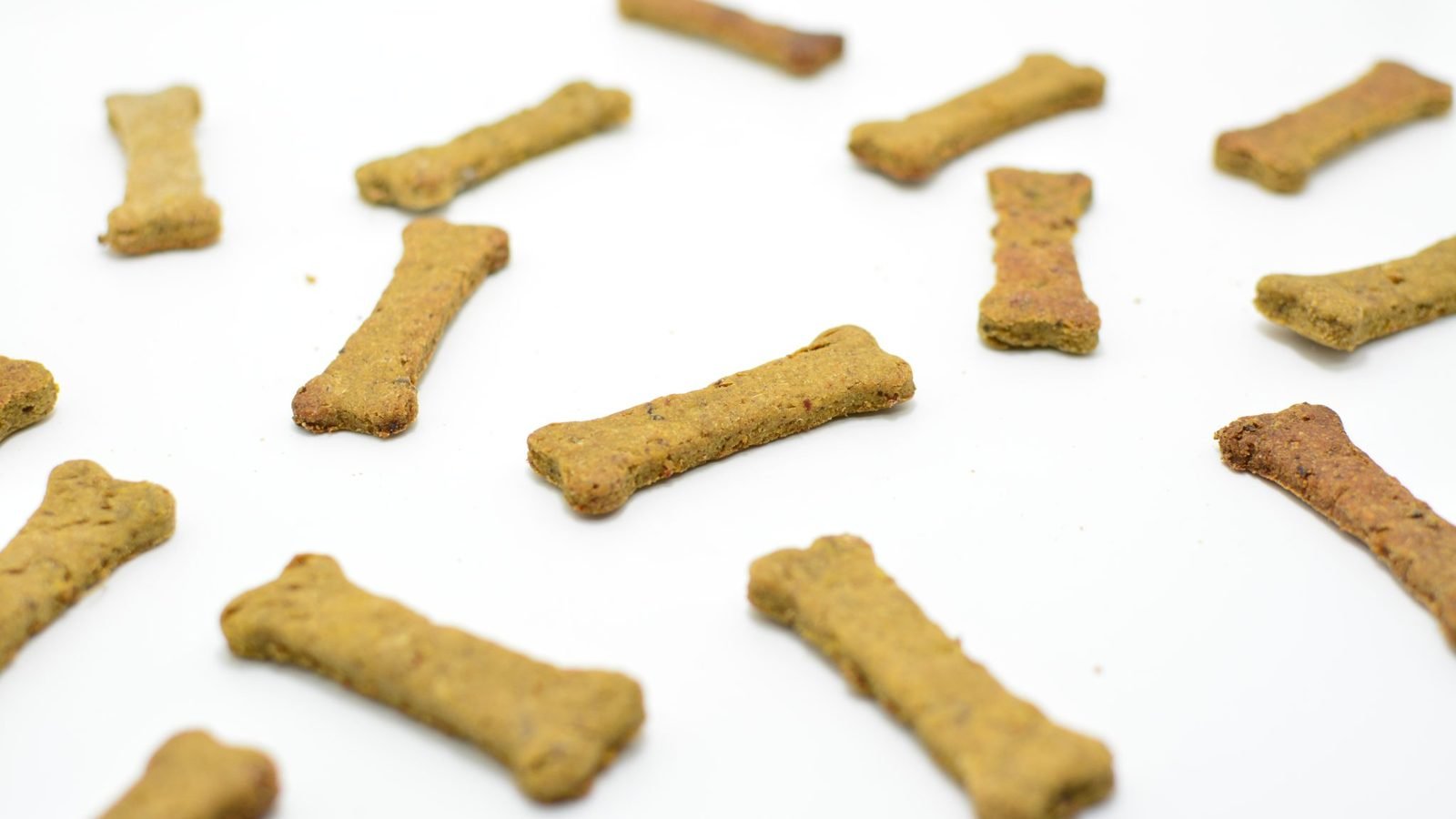
The dog treat recipes that are simplest and safest are three-part biscuits: a protein (liver or cooked chicken), a binder (egg) and a flour such as ground oats. No salt, sugar, onion, garlic or sweeteners.
The point almost no recipe mentions: without preservatives they only last a few days in the fridge. They're a treat to make in small batches, not to stock the pantry.
Making treats at home has one advantage no product can match: you control every ingredient. If your dog can't tolerate something, cooking yourself is the most direct way to know what they're eating. This article has two recipes that work, the list of what should never go into the mix, an honest look at storage and an important note about complete homemade diets.
What can go in and what can't
| Yes | No, never |
|---|---|
|
|
Xylitol is the most dangerous mistake in home cooking. It shows up in "light" peanut butters, sugar-free fruit purees and diabetic products you use without thinking. Read the label every time, even if it's your usual brand. The full list is in foods dogs can't eat, and the fruits and vegetables you can use, in which fruits dogs can eat.
Recipe 1: liver biscuits, 3 ingredients
The simplest one, and the one dogs get most excited about. Liver has an aroma almost every dog loves, so it works both as an everyday treat and as a training reward.
Ingredients
- 250 g beef liver
- 1 egg
- Ground oats, about one cup
Directions
- Blend the raw liver with the egg into a smooth paste.
- Add the ground oats little by little, until the mixture stops sticking to your fingers.
- Spread on baking paper half a centimeter thick and score into squares with a knife.
- Bake at 170 °C for 20 to 25 minutes, until firm and dry to the touch.
- Let cool completely before storing.
Liver is a very concentrated food, so these biscuits are given in small portions and never as the base of the diet. We explain it in the article on liver biscuits for dogs. The egg is fully cooked in the oven, which is how a dog should eat it.
Recipe 2: chicken and carrot biscuits
The gentle option, for dogs that find organ meat heavy or turn down strong flavors.
Ingredients
- 1 cooked chicken breast, unsalted and unseasoned
- 1 medium carrot, finely grated
- 1 egg
- Ground oats, about one cup
Directions
- Shred the chicken as finely as possible or run it through the food processor.
- Mix with the carrot and egg.
- Add oats until you get a workable dough.
- Form small balls and flatten them with a fork.
- Bake at 170 °C for 25 to 30 minutes.
- Cool completely before storing.
The carrot adds moisture, so these biscuits usually need a few extra minutes in the oven. Introduction rule: one new ingredient at a time, and wait a couple of days before adding another. It's the only way to know which one caused a reaction if one shows up.
How long they really last
Here's the fact that decides whether homemade biscuits fit your routine.
| How you store them | What to expect |
|---|---|
| Airtight container in the fridge | A few days. Make small batches |
| Freezer, in portions | Quite a bit longer; thaw only what you need for the day |
| Out of the fridge | Very little. Don't leave them in the pantry |
The reason is moisture. A home oven bakes, but it doesn't dry evenly: it leaves residual moisture, more in the center than at the edges. That moisture is what lets mold grow, and in a protein biscuit it can appear before you see it. That's why it's key to let them cool completely before storing: trapped heat creates condensation.
Signs to throw out a batch: sour or rancid smell, spots, a sticky or soft texture in pieces that came out firm. When in doubt, throw it out.
What about a complete homemade diet?
Many people searching for dog recipes aren't thinking about treats but about replacing kibble with homemade food. That's a different conversation. According to VCA Animal Hospitals, a balanced diet for dogs needs the right amount and ratio of several essential nutrients —amino acids, fatty acids, vitamins and minerals— and you can't get that by eyeballing ingredients.
If you want to feed your dog homemade food, design the diet with a veterinarian. The biscuits in this article are treats: they count within the 10% of daily calories that WSAVA recommends as the maximum for extras. If the topic interests you, start with our practical guide to natural dog food.
When it makes sense to buy them ready-made
Cooking at home and buying aren't opposing camps. Each one solves a different problem:
| Situation | What works best |
|---|---|
| Your dog has intolerances and you need full control | Homemade, ingredient by ingredient |
| You want to give them something special on a weekend | Homemade, no doubt |
| You give treats daily and train several times a week | Store-bought: the volume it takes isn't practical at home |
| You need to carry treats in your pocket to the park | Store-bought: homemade ones crumble and stain |
| You want a long chewing session | A chew, not a biscuit |
The useful test isn't "homemade vs. store-bought," it's the label: few, recognizable ingredients, and no sugar, salt or additives you don't need.
My Pet Biscuits
Made in La Estrella, Antioquia, by an ICA-certified Colombian manufacturer. No rawhide, no artificial preservatives or colorants.
- Liver Biscuits — in 175, 500 and 700 g, and Puppy line, 1000 g.
- Chicken & Carrot Biscuits — the gentle option, in 150, 500 and 800 g.
My Pet Team
The My Pet content team. My Pet is a Colombian maker of 100% natural dog treats and edible chews, produced in La Estrella, Antioquia, with certification from the Colombian Agricultural Institute (ICA).
This guide is for information only and does not replace a visit to the vet.
More about us on About us.
Frequently asked questions
How long do homemade dog biscuits last?
Not long. With no preservatives and the moisture a home oven leaves behind, they're stored in the fridge in an airtight container and eaten within a few days. Frozen, they keep quite a bit longer. Check each batch before serving: a sour smell, spots or a soft texture are reasons to throw it out.
What flour can I use for dog biscuits?
Ground oats are a simple, common option, and rice flour works too. What matters is what shouldn't go in: sugar, salt, sweeteners and baking mixes made for people, which often contain unnecessary additives. If your dog has any intolerance, check with your vet first.
Can I give homemade biscuits to a puppy?
Yes, in small pieces and as a treat, not as a meal. Puppies need food formulated for growth, so treats should be few and not replace their meals. Introduce any new ingredient one at a time so you can tell if something doesn't agree with them.
Can I feed my dog only homemade food?
Not with random recipes. A complete diet for dogs needs the right amount and ratio of many nutrients, as VCA Animal Hospitals explains, and you can't get that by eyeballing it. If you want to feed them homemade food, design the diet with a veterinarian. The biscuits in this article are treats, not meals.
Are homemade biscuits better than store-bought?
Neither is better in the abstract. At home you control every ingredient, and that's a real advantage if your dog has intolerances. In exchange you give up shelf life and convenience. If you buy, the useful test is the label: few, recognizable ingredients and no sugar, salt or additives you don't need.
Summary
- Three parts: protein, egg and ground oats. No salt, no sugar, no sweeteners.
- Xylitol is the most dangerous mistake in home cooking; it sneaks into "light" products.
- They last a few days in the fridge. Cool completely, make small batches and freeze the rest.
- Biscuits are treats, not food. A complete homemade diet is designed with a veterinarian.
- Homemade for control, store-bought for volume. The real test is the label.
Which recipe did you try and how did it turn out? Tell us in the comments.
References
- VCA Animal Hospitals — Nutrition: General Feeding Guidelines for Dogs — What a balanced diet needs.
- American Kennel Club — Can Dogs Eat Eggs? — Cooked vs. raw egg.
- ASPCA — People Foods to Avoid Feeding Your Pets — Ingredients to avoid.
- WSAVA — Global Nutrition Guidelines — The 10% rule for treats.
- ICA — Food safety in agri-food chains — Colombia's food safety framework for animal-origin products.